Summary
- Salt is often criticised for being unhealthy and potentially dangerous, but are these criticisms always valid?
- This blog post will explore these risks, while also delving into some lesser-known benefits of salt intake, like hydration, muscle function, and hormone health.
- Most of us consume enough sodium per day but not enough of the other main electrolytes, particularly potassium.
- Having the right balance between sodium, these other electrolytes, and water will help you to achieve optimal hydration, and optimal testosterone.
Background
Everyone has heard of salt, but let's check your knowledge with some facts that get increasingly more niche.
Salt is made up of two separate essential micronutrients: sodium and chloride (roughly 40% sodium and 60% chloride). Only about 10% of our sodium comes from salt we add ourselves – around 5% at the table and 6% in home cooking. The overwhelming majority is already in the food we buy, and less than 0.5% comes from tap water.[1]

The World Health Organisation recommends consuming less than 2000mg of sodium a day.[2] Hardly anyone manages it – fewer than 11% of US adults stay under even the more lenient 2300mg guideline.[3] We're also advised to get 2300mg of chloride a day, as it is involved in a number of health processes like hydration, muscle function, and digestive health.[4]
It is not uncommon for an athlete to sweat out more than half their daily intake target for sodium and chloride (roughly 1020mg and 1600mg per litre of sweat, respectively) in just one hour of physical exercise.[5][6] We also sweat out the other electrolytes: potassium, calcium, and magnesium.
Sodium and chloride are both electrolytesMinerals that carry an electrical charge when dissolved in water, like sodium, potassium, calcium, and magnesium., meaning that they dissolve in water, carry an electrical current, and are crucial for hydration. They complement each other, as sodium carries a positive charge while chloride carries a negative one. This "electrical neutrality" is crucial for cellular stability, nerve signalling, muscle function, and hydration. This is handy, because dietary chloride is almost always bound to sodium – it reaches us as salt.[4]
Despite being the most abundant electrolyte in our diets, chloride is less well-known than sodium, mostly because high chloride intakes are not associated with the same degree of harm that high sodium intakes are.
Finally, Roman soldiers are often said to have been paid in salt, giving us the word "salary" from the Latin "salarium". Historians are sceptical of the salt-payment story, though the word itself does share a root with "sal".
Is Salt Bad for You?
So, what does salt do for our health? I'm going to assume you want the bad news before the good. Well, sodium intake specifically has been associated with cardiovascular disease, kidney dysfunction, and high blood pressure.[7]
If you just looked at the above findings, I wouldn't blame you for throwing salt over your shoulder. But, before you do, check out this literature review from 2014.[8] In it, the researchers reference a number of studies that show that high sodium isn't the main issue – it's more the sodium-to-potassium ratio, as it's a far better predictor of all-cause mortality than sodium alone. The exact ratio hasn't been found, but the World Health Organisation recommends less than one gram of sodium for every gram of potassium.[2]
In 2021, the European Heart Journal provided further evidence of salt not being our enemy. This involved a massive analysis on sodium intake, life expectancy, and all-cause mortality across 181 countries.[9] It found that sodium intake was positively correlated with life expectancy and negatively correlated with all-cause mortality. The researchers wondered if malnutrition was driving these results, so they conducted another analysis, this time on just the 46 wealthiest countries in their analysis – the results still rang true.
These results were supported in 2024, when data from over 13,000 American participants demonstrated a negative correlation between sodium intake and all-cause mortality.[10] This study also found that potassium intake was inversely associated with all-cause mortality.
We can keep eating salt, so long as we're eating enough potassium.
But why should we, what are the benefits (other than maybe saving your life)? Well, it's crucial for nerve health, nutrient absorption, hydration, muscle function, and athletic performance.[11] In a fascinating study on triathletes, those who replaced the sodium they lost in their sweat finished the race an average of 26 minutes faster.[11] But who cares about all this, how does salt impact test?
Animal Studies
There have been a few rat studies that have investigated the impacts of salt on testosterone.
This Nigerian study found that rats fed a high salt diet, where salt was 8% of their total diet, had almost twice as much testosterone as those fed a control diet, where salt was 0.3% of their total diet (18.7ng/mL compared to 9.9ng/mL).[12] For context, a diet that is 8% salt is the equivalent of roughly 50g/day for a 70kg male, and five times the average intake.
So, does this mean we should go out there and eat 10 tablespoons of salt per day? Well, I wouldn't. The high salt group in this study had higher levels of oxidative stressAn imbalance between free radicals, which damage cells, and the antioxidants that neutralise them. in the testes as well as more abnormal sperm cells. Interestingly, there was a third group in the study: rats that were fed a low salt diet, where salt was 0.14% of their total diet. This group also had higher levels of oxidative stress in the testes, more abnormal sperm cells, and reduced sperm counts.
This Korean study found that rats fed diets containing 1% salt or 4% salt had similar androgensMale sex hormones, including testosterone and DHT. to those fed a control diet, but dramatically decreased estrogensThe main female sex hormone. Men make it too, mostly by converting testosterone..[13] While this drop in estrogen might sound appealing, the high salt groups demonstrated evidence of oxidative stress, kidney damage, and gut inflammation – not so appealing.
Indian researchers in 2023 fed mice either 4% salt (high salt), 0.4% salt (low salt), or 0.8% salt (control group) and found that both the high and low salt groups had lower testosterone than the control group.[14]
Human Studies
Unfortunately, there aren't any studies that clarify what impact salt has on testosterone in humans. But there are a few that come close.
Physical, Mental, and Sexual Health
The closest one I could find was done by Italian researchers in 2023. They surveyed over 3000 men aged 40–79 and found that the relationship between their sodium levels and physical function, mental health scores, and sexual function was parabolic.[15] In simple terms, those with normal blood sodium levels (136–147mmol/L) had better physical, mental, and sexual health than those with high (>147mmol/L) or low (<136mmol/L) sodium levels.
Sleep
Sodium also has a parabolic relationship with sleep, with both low and high intakes being associated with poorer sleep quality.[16][17] Confusingly, a Korean study on both men and women found sodium was negatively associated with sleep, while a Japanese study on just men found it was positively associated with sleep.[18][19] As you can see, the research here isn't super clear, so I just try to focus on maintaining an optimal sodium-to-potassium ratio and drinking enough water, as these are stronger predictors of health.
Cortisol
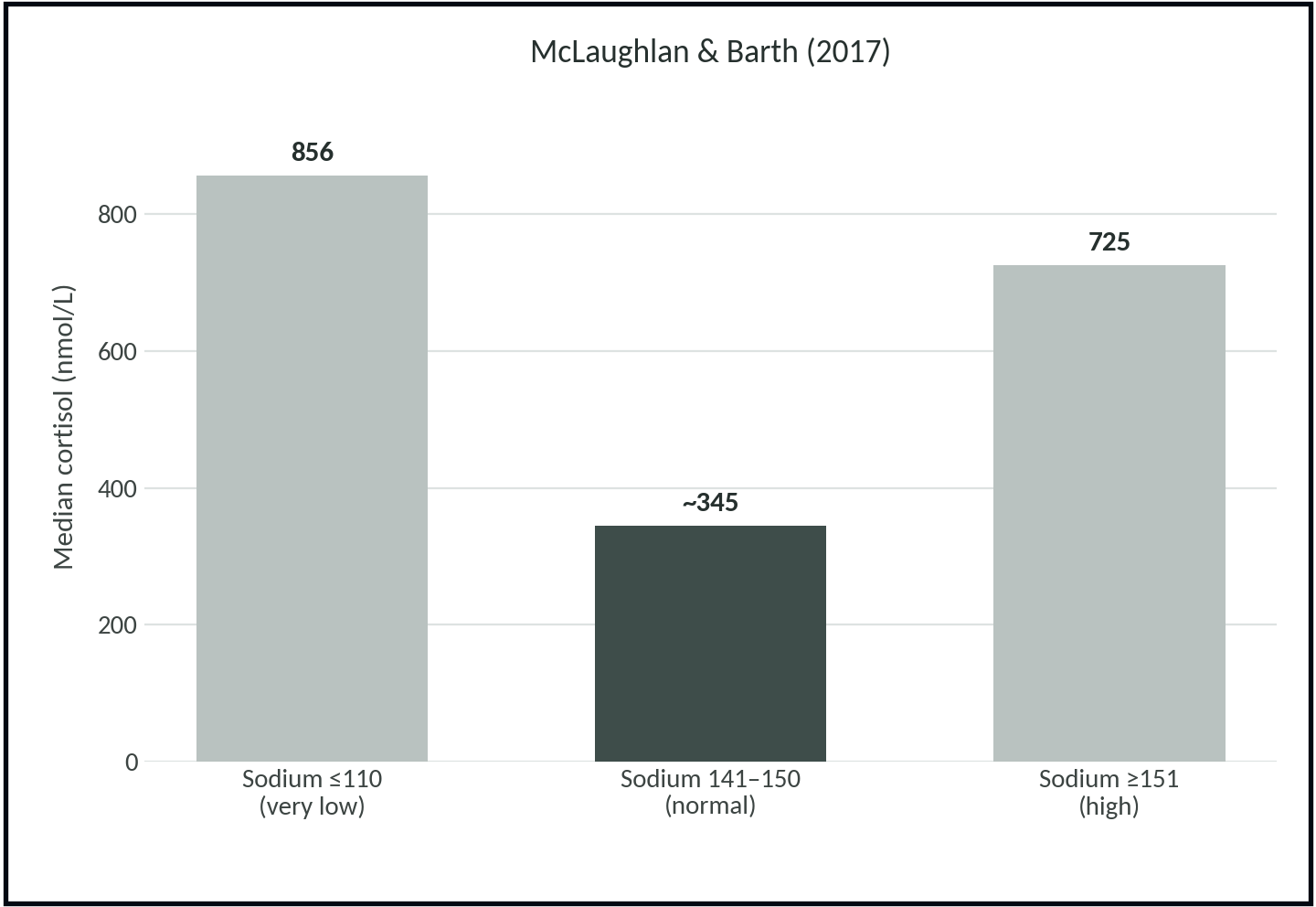
One more parabolic study – this time on cortisolThe body's main stress hormone. Chronically high levels can suppress testosterone production.. In 2017, British researchers analysed 3268 hospital patients and found that cortisol was highest at both ends of the sodium range.[20] Patients with sodium at or below 110mmol/L had a median cortisol of 856nmol/L, and cortisol then fell steadily as sodium rose. The lowest cortisol levels were found in the 141–150mmol/L band – around 60% below the very low sodium group and 52% below those at 151mmol/L or above.
Hydration
The final study I'll reference isn't specifically on sodium, but on hydration, which sodium is crucial for. This study was done on young resistance trained American men and had them perform six sets of squats at varying states of hydration.[21] There were three groups: hydrated, dehydrated (2.5% dehydration), and significantly dehydrated (5.0% dehydration). All three groups were dehydrated to the same extent, before being rehydrated to varying degrees with water and electrolyte tablets (containing sodium).
The dehydrated group produced 10% less testosterone than the hydrated group in response to the session, while the significantly dehydrated group produced 16% less. On top of this, the dehydrated group had 16% more cortisol than the control group, while the significantly dehydrated group had 42% more cortisol.
Mechanisms
Through what mechanisms does salt influence our testosterone?
| Mechanism | What sodium does | Why it matters for testosterone |
|---|---|---|
| Hydration | Is crucial for hydration.[11] | Dehydration reduces our ability to produce testosterone.[21] |
| Sleep | Healthy levels are important for sleep.[16][17] | Sleep is crucial for testosterone.[22] |
| Cortisol | Healthy levels help to maintain healthy cortisol levels.[20] | Cortisol inhibits testosterone.[23] |
| Oxidative stress | Excess sodium can cause increased oxidative stress.[12] | Higher oxidative stress is associated with lower testosterone.[24] |
| Blood pressure | A sodium-to-potassium ratio that favours sodium is associated with hypertensionHigh blood pressure..[25] | Hypertension is negatively correlated with testosterone.[26] |
Dosage
So, how much should we eat? Well, as I've explained throughout, the sodium-to-potassium balance is a more important consideration than sodium intake alone. The average sodium-to-potassium ratio is 1.4:1.[8] I try to keep mine at or below 1:1. To do this, I focus more on increasing potassium than on reducing sodium, as this helps me to maintain optimal hydration.
While we're on the topic, you've probably heard that to promote hydration, it's important to "replace the electrolytes lost in sweat". What's the truth in this? Well, while estimates vary, in each litre we sweat, we appear to lose approximately 1600mg of chloride,[6] 1020mg of sodium,[5] 265mg of potassium,[27] 20mg of calcium,[28] and 12mg of magnesium.[29]
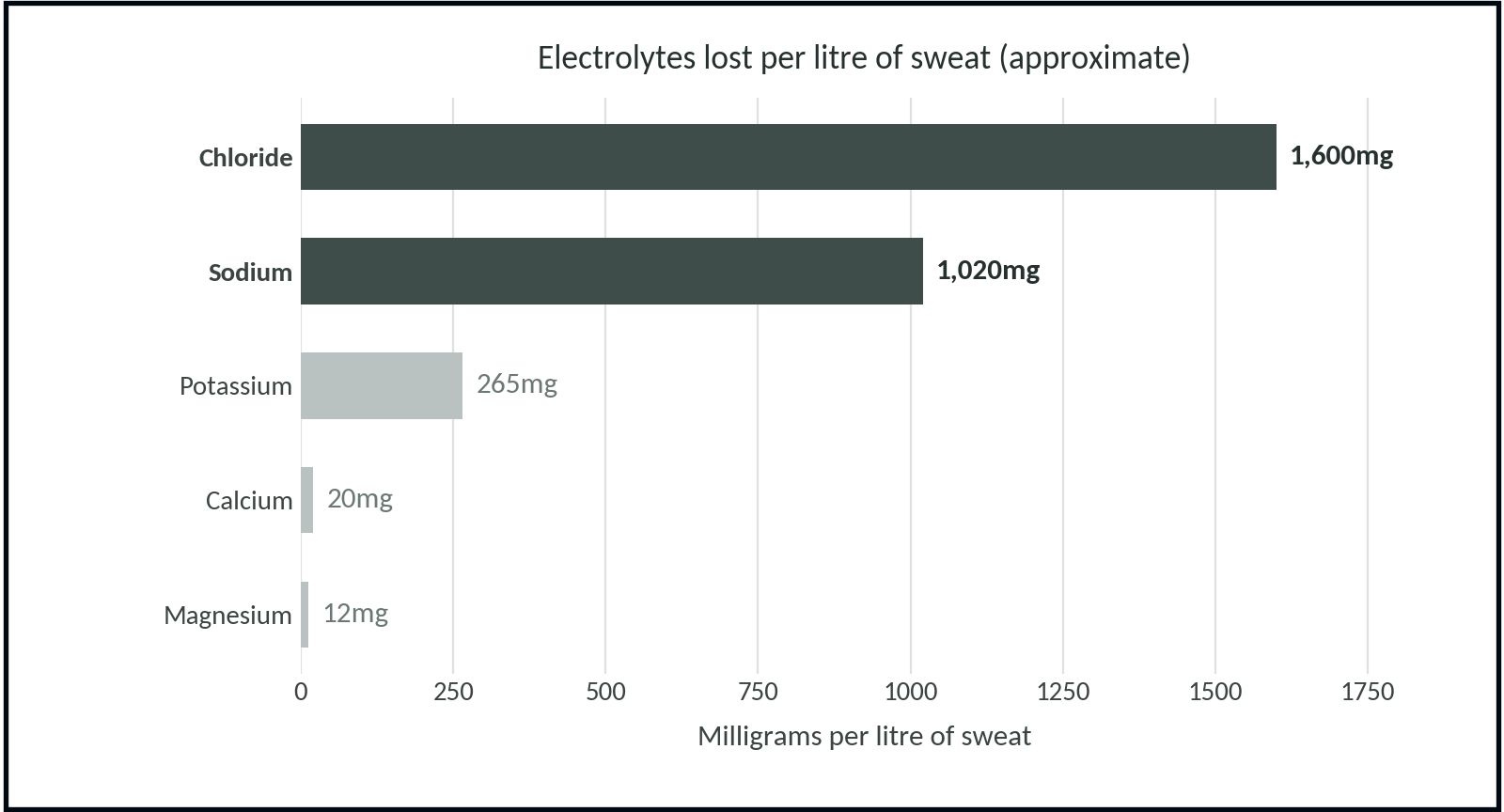
So, if you sweat two litres a day, a pretty standard amount, you're losing around 2000mg of sodium! As we saw before, replacing these losses can improve athletic performance.[11] That's what I try to do, as this helps to maintain moderate sodium levels.
A 2021 literature review out of Canada supports this, as the researchers found that intakes of 3–5g/day were associated with lower risks of cardiovascular disease and mortality than intakes above 5g/day or below 3g/day.[30]
Therefore, I try to consume around this amount, or a little more if it's a particularly sweaty day. More importantly, I prioritise potassium so that my intake of it remains slightly higher than my intake of sodium.
Conclusion
Look, the research on sodium chloride and testosterone is mixed, so take it with a grain of salt.
What is less mixed is the evidence against sodium restriction and excess – both are associated with a range of health concerns.
On the other hand, normal levels of sodium, especially when balanced with potassium, are associated with better physical, mental, and sexual health, as well as improved sleep, stress, and hydration.
So, when it comes to salt and testosterone, it's as my grandma says: "everything in moderation".
Andregen utilises contemporary scientific research to provide first-rate information and unparalleled supplements that support health and optimise testosterone.
References
- Harnack, L. J., Cogswell, M. E., Shikany, J. M., Gardner, C. D., Gillespie, C., Loria, C. M., Zhou, X., Yuan, K., & Steffen, L. M. (2017). Sources of sodium in US adults from 3 geographic regions. Circulation, 135(19), 1775–1783. https://doi.org/10.1161/CIRCULATIONAHA.116.024446 ↩
- World Health Organization. (2012). Guideline: Sodium intake for adults and children. World Health Organization. https://www.who.int/publications/i/item/9789241504836 ↩
- Jackson, S. L., Coleman King, S. M., Zhao, L., & Cogswell, M. E. (2016). Prevalence of excess sodium intake in the United States—NHANES, 2009–2012. MMWR. Morbidity and Mortality Weekly Report, 64(52), 1393–1397. https://doi.org/10.15585/mmwr.mm6452a1 ↩
- Institute of Medicine. (2005). Dietary reference intakes for water, potassium, sodium, chloride, and sulfate. National Academies Press. https://doi.org/10.17226/10925 ↩
- Ranchordas, M. K., Tiller, N. B., Ramchandani, G., Jutley, R., Blow, A., Tye, J., & Drury, B. (2017). Normative data on regional sweat-sodium concentrations of professional male team-sport athletes. Journal of the International Society of Sports Nutrition, 14, 40. https://doi.org/10.1186/s12970-017-0197-4 ↩
- Baker, L. B., De Chavez, P. J. D., Ungaro, C. T., Sopeña, B. C., Nuccio, R. P., Reimel, A. J., & Barnes, K. A. (2019). Exercise intensity effects on total sweat electrolyte losses and regional vs. whole-body sweat [Na+], [Cl−], and [K+]. European Journal of Applied Physiology, 119(2), 361–375. https://doi.org/10.1007/s00421-018-4048-z ↩
- Hunter, R. W., Dhaun, N., & Bailey, M. A. (2022). The impact of excessive salt intake on human health. Nature Reviews Nephrology, 18(5), 321–335. https://doi.org/10.1038/s41581-021-00533-0 ↩
- Levings, J. L., & Gunn, J. P. (2014). The imbalance of sodium and potassium intake: Implications for dietetic practice. Journal of the Academy of Nutrition and Dietetics, 114(6), 838–841. https://doi.org/10.1016/j.jand.2014.02.015 ↩
- Messerli, F. H., Hofstetter, L., Syrogiannouli, L., Rexhaj, E., Siontis, G. C. M., Seiler, C., & Bangalore, S. (2021). Sodium intake, life expectancy, and all-cause mortality. European Heart Journal, 42(21), 2103–2112. https://doi.org/10.1093/eurheartj/ehaa947 ↩
- Liu, D., Tian, Y., Wang, R., Zhang, T., Shen, S., Zeng, P., & Zou, T. (2024). Sodium, potassium intake, and all-cause mortality: Confusion and new findings. BMC Public Health, 24, 180. https://doi.org/10.1186/s12889-023-17582-8 ↩
- Del Coso, J., González-Millán, C., Salinero, J. J., Abián-Vicén, J., Areces, F., Lledó, M., Lara, B., Gallo-Salazar, C., & Ruiz-Vicente, D. (2016). Effects of oral salt supplementation on physical performance during a half-ironman: A randomized controlled trial. Scandinavian Journal of Medicine & Science in Sports, 26(2), 156–164. https://doi.org/10.1111/sms.12427 ↩
- Iranloye, B. O., Oludare, G. O., Morakinyo, A. O., Esume, N. A., & Ekeh, L. C. (2013). Reproductive parameters and oxidative stress status of male rats fed with low and high salt diet. Journal of Human Reproductive Sciences, 6(4), 267–272. https://doi.org/10.4103/0974-1208.126308 ↩
- Chanmuang, S., Kim, B. M., Gu, S. Y., Son, Y. J., Le, H. G., Nam, Y. D., Song, E. J., Ham, K. S., & Kim, H. J. (2022). Effects of sea salt intake on metabolites, steroid hormones, and gut microbiota in rats. PLoS ONE, 17(8), e0269014. https://doi.org/10.1371/journal.pone.0269014 ↩
- Saugandhika, S., Sapra, L., Kumari, K., & Srivastava, R. K. (2023). High salt diet impairs male fertility in mice via modulating the skeletal homeostasis. Reproductive Sciences, 30(11), 3339–3352. https://doi.org/10.1007/s43032-023-01278-w ↩
- Norello, D., Rastrelli, G., Antonio, L., Bartfai, G., Casanueva, F. F., Giwercman, A., Huhtaniemi, I. T., O'Neill, T. W., Punab, M., Slowikowska-Hilczer, J., Tournoy, J., Vanderschueren, D., Wu, F. C. W., Maggi, M., & Peri, A. (2024). Hyponatremia, hypernatremia and impairment of functional, psychological and sexual domains. Journal of Endocrinological Investigation, 47, 1005–1014. https://doi.org/10.1007/s40618-023-02218-w ↩
- Vitiello, M. V., Prinz, P. N., & Halter, J. B. (1983). Sodium-restricted diet increases nighttime plasma norepinephrine and impairs sleep patterns in man. The Journal of Clinical Endocrinology and Metabolism, 56(3), 553–556. https://doi.org/10.1210/jcem-56-3-553 ↩
- Matsuo, T., Miyata, Y., & Sakai, H. (2019). Effect of salt intake reduction on nocturia in patients with excessive salt intake. Neurourology and Urodynamics, 38(3), 927–933. https://doi.org/10.1002/nau.23929 ↩
- Jung, J. Y., Oh, C.-M., Kim, E., & Park, S. K. (2023). Dietary sodium intake and its relation to sleep duration, sleep quality and nocturnal urination in working-aged Korean adults. Nutrition Bulletin, 48(3), 365–375. https://doi.org/10.1111/nbu.12629 ↩
- Komada, Y., Narisawa, H., Ueda, F., Saito, H., Sakaguchi, H., Mitarai, M., Suzuki, R., Tamura, N., Inoue, S., & Inoue, Y. (2017). Relationship between self-reported dietary nutrient intake and self-reported sleep duration among Japanese adults. Nutrients, 9(2), 134. https://doi.org/10.3390/nu9020134 ↩
- McLaughlan, E., & Barth, J. H. (2017). An analysis of the relationship between serum cortisol and serum sodium in routine clinical patients. Practical Laboratory Medicine, 8, 30–33. https://doi.org/10.1016/j.plabm.2017.04.003 ↩
- Judelson, D. A., Maresh, C. M., Yamamoto, L. M., Farrell, M. J., Armstrong, L. E., Kraemer, W. J., Volek, J. S., Spiering, B. A., Casa, D. J., & Anderson, J. M. (2008). Effect of hydration state on resistance exercise-induced endocrine markers of anabolism, catabolism, and metabolism. Journal of Applied Physiology, 105(3), 816–824. https://doi.org/10.1152/japplphysiol.01010.2007 ↩
- Leproult, R., & Van Cauter, E. (2011). Effect of 1 week of sleep restriction on testosterone levels in young healthy men. JAMA, 305(21), 2173–2174. https://doi.org/10.1001/jama.2011.710 ↩
- Ullah, R., Naz, R., Batool, A., Wazir, M., Rahman, T. U., Nabi, G., Wahab, F., Fu, J., & Shahab, M. (2021). RF9 rescues cortisol-induced repression of testosterone levels in adult male macaques. Frontiers in Physiology, 12, 630796. https://doi.org/10.3389/fphys.2021.630796 ↩
- Liu, J., Ma, C., Leng, Y., Qin, J., & Zhang, P. (2025). Association between the oxidative balance score and testosterone deficiency: A cross-sectional study of the NHANES, 2011–2016. Scientific Reports, 15, 8040. https://doi.org/10.1038/s41598-025-92934-5 ↩
- Perez, V., & Chang, E. T. (2014). Sodium-to-potassium ratio and blood pressure, hypertension, and related factors. Advances in Nutrition, 5(6), 712–741. https://doi.org/10.3945/an.114.006783 ↩
- Wei, D., Hou, J., Liu, X., Zhang, L., Wang, L., Liu, P., Fan, K., Zhang, L., Nie, L., Xu, Q., Wang, J., Song, Y., Wang, M., Liu, X., Huo, W., Yu, S., Li, L., Jing, T., Wang, C., & Mao, Z. (2021). Interaction between testosterone and obesity on hypertension: A population-based cross-sectional study. Atherosclerosis, 330, 14–21. https://doi.org/10.1016/j.atherosclerosis.2021.06.906 ↩
- Consolazio, C. F., Matoush, L. O., Nelson, R. A., Harding, R. S., & Canham, J. E. (1963). Excretion of sodium, potassium, magnesium and iron in human sweat and the relation of each to balance and requirements. The Journal of Nutrition, 79(4), 407–415. https://doi.org/10.1093/jn/79.4.407 ↩
- Consolazio, C. F., Matoush, L. O., Nelson, R. A., Hackler, L. R., & Preston, E. E. (1962). Relationship between calcium in sweat, calcium balance, and calcium requirements. The Journal of Nutrition, 78(1), 78–88. https://doi.org/10.1093/jn/78.1.78 ↩
- Baker, L. B., & Jeukendrup, A. E. (2014). Optimal composition of fluid-replacement beverages. Comprehensive Physiology, 4(2), 575–620. https://doi.org/10.1002/cphy.c130014 ↩
- Mente, A., O'Donnell, M., & Yusuf, S. (2021). Sodium intake and health: What should we recommend based on the current evidence? Nutrients, 13(9), 3232. https://doi.org/10.3390/nu13093232 ↩